Blog
SMS Marketing Statistics for 2026: Why Text Messaging Continues to Outperform Every Other Channel
If you’re trying to reach customers in 2026, you already know attention is harder than ever to earn. Email inboxes are overflowing, algorithms shift weekly, and phone calls have practically turned into antiques. Let’s dive into SMS Marketing Statistics for 2026.
Yet one channel continues to rise above the noise every single year:
SMS Marketing — the highest-engagement communication channel on the planet.
We’ve gathered the most important SMS marketing statistics for 2026 from reputable, industry-leading studies, combined with real-world performance metrics seen across Project Broadcast’s public-sector and political-sector outcomes .
Let’s explore why texting is still the most effective way to reach people in 2026—and what these trends mean for your business, organization, or campaign.
SMS Open Rates in 2026: Still 90–98% (Virtually Unmatched)
SMS continues to boast 90–98% open rates, depending on the industry.
- Gartner Research reports SMS open rates above 90%, significantly outperforming email.
- Forbes confirms SMS messages are opened 98% of the time, usually within minutes.
Compare that to email, which still hovers around a modest 20–30% open rate.
It’s no wonder public-sector agencies choose SMS as their “can’t miss” communication method, citing trusted, direct, and impossible-to-miss delivery.
SMS Response Rates: 45%+ vs. Email’s 6%
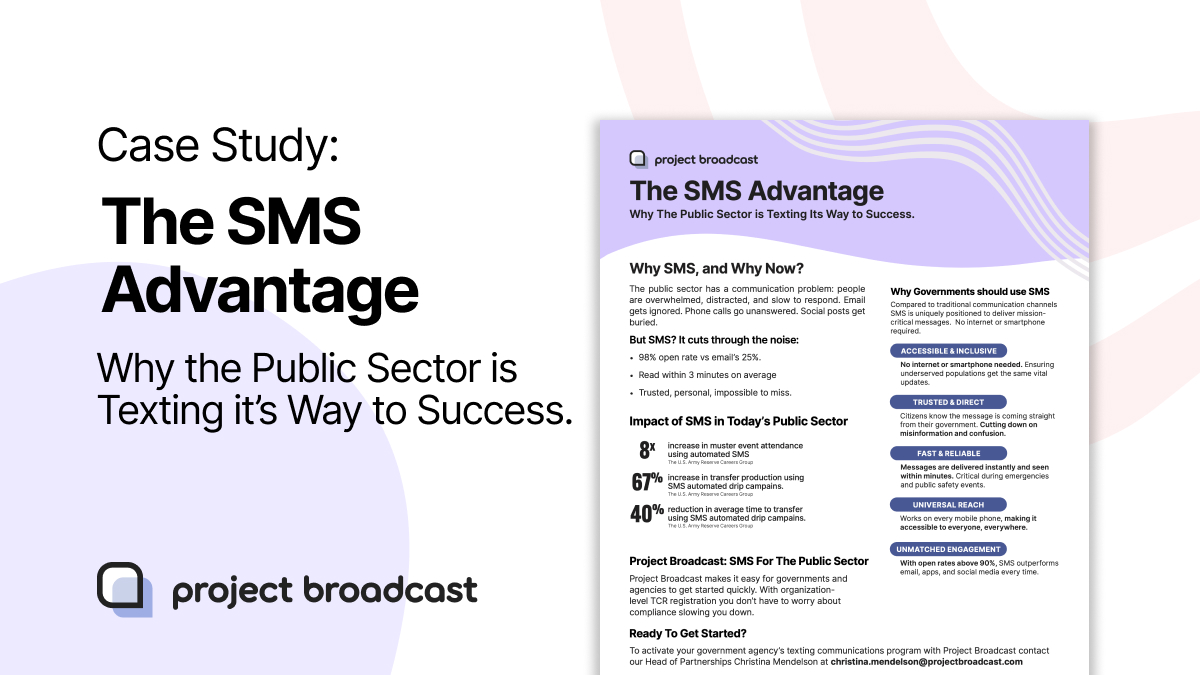
While email averages a 6% response rate, SMS averages 45%+, with some industries reporting even higher reply rates. That responsiveness is exactly why automated drip campaigns in public-sector programs showed:
- 67% increase in transfer production
- 40% reduction in transfer time
When people actually see your message, they can actually act on your message.
SMS Read Time: 90% Read Within 3 Minutes
Across nearly every SMS industry benchmark:
- 90% of text messages are read within 3 minutes
This matches exactly what we’ve documented in public-sector communication performance, where messages are read almost immediately when timing is critical .
For time-sensitive content like event reminders, alerts, system updates, sales, or appointment confirmations, SMS is simply unbeatable.
SMS Is the Most Accessible Marketing Channel in 2026
SMS doesn’t require:
❌ Wi-Fi
❌ A smartphone
❌ An app
❌ A social media account
That’s increasingly important in 2026, as digital access gaps continue to grow.
Our public-sector studies show SMS ensures universal reach, even in low-tech or underserved communities, because every mobile phone can receive texts .
Industry sources reinforce this:
- Pew Research: 97% of Americans own a mobile phone capable of receiving SMS.
- GSMA Mobile Economy Report: SMS remains the most universally supported communication channel worldwide.
If your audience has a phone number, you can reach them.
SMS Automation Is Skyrocketing. Up 30-40% Across Industries
Automation is the biggest growth trend in SMS for 2026.
Businesses are increasingly using:
- Automated drip campaigns
- Keyword-triggered messages
- Behavior-based workflows
- Personalized merge fields
- SMS + voice automation hybrid flows
Project Broadcast users see this reflected firsthand. Our tools make automated campaigns easy to launch and scale, even for small or non-technical teams.
SMS Drives Higher Conversions: 20-45% (Depending on Industry)
Conversion data remains extremely strong:
- Retail & e-commerce: 29–45% conversion rates on SMS campaigns
- Local service businesses: 25–35% average conversion on reminders, offers, and follow-ups
- Political campaigns:
- 14.4% increase in voter turnout
- 7% uplift in precinct engagement
- 4% increase in swing-voter performance
- Public sector programs: 8× event attendance increase with SMS
For comparison, average e-commerce conversion rates across all channels are 2–3%.
SMS isn’t
just better, it’s in a completely different league.
SMS Remains Cost-Efficient (even as ad costs rise in 2026)
With rising CPMs and reduced tracking visibility due to privacy changes, SMS remains one of the
most
affordable, predictable marketing channels.
Political campaigns using Project Broadcast have saved over $30,000 compared to traditional outreach strategies. This makes SMS one of the highest-ROI channels available—especially when automated.
SMS Works Across Every Industry in 2026
No other channel is as universally adaptable.
Industries seeing the biggest lift:
1. Retail & E-commerce
2. Real Estate
3. Direct Sales & Network Marketing
- Team communication
- Customer reactivation
- Promo reminders
4. Public Sector
- Emergency alerts
- Event reminders
- Program participation boosts
5. Political Campaigns
6. Nonprofits & Churches
- Donation drives
- Service reminders
- Event updates
7. Coaches, Educators & Digital Creators
If your audience has a phone number, SMS works.
The Future of SMS Marketing in 2026 and Beyond
Based on what we’ve seen, here’s what’s coming:
1. Hyper-Personalized Messaging
Micro-segmentation will drive higher conversion than ever.
2. AI-Enhanced Message Optimization
Better timing, frequency, and audience prediction. Learn more about AIVA, Project Broadcast’s AI assistant >>
3. SMS + Voice Hybrid Campaigns
Integrated communication flows with voice drops (already supported in Project Broadcast).
4. Expansion of A2P Messaging
More business-to-consumer messaging across industries.
5. Increased Demand for Compliance-Ready Messaging
Organizations want platforms that
simplify TCR registration
and regulations,
a major strength of Project Broadcast’s easy
set up process.
Final Takeaway: SMS Is Still the Most Powerful Marketing Channel in 2026
After reviewing all modern data—and thousands of real-world results—one thing is clear:
If you want your message seen, read, and acted on, SMS remains the most effective way to
communicate.It’s fast.
It’s personal.
It’s affordable.
It’s universal.
And it works
across nearly every industry and organization type.